
For a long time, many people imagine an unborn baby as a sleeping being that simply develops inside the mother’s womb. In fact, the opposite is true: incredibly complex processes are already taking place during pregnancy. The baby moves, exercises its muscles, develops its senses, and perceives its surroundings in a unique way. Some abilities emerge earlier than many parents realize. Others develop gradually as the brain, nervous system, and organs mature.
1. The Heart Begins to Beat Before Many Women Even Know they’re Pregnant
One of the most fascinating developments takes place very early on. Just a few weeks after fertilization, the embryo’s heart begins to develop. At first, it is not yet a fully formed heart as it will be at birth, but rather a simple structure that develops step by step. The first heart cells give rise to a complex organ with heart chambers, heart valves, and blood vessels.
The heartbeat can already be seen on an early ultrasound in many pregnancies. At this stage, the heart is only a few millimeters in size—but it is already functioning on its own.

Did you know?
The heart is one of the first organs to begin functioning. The reason for this is that the growing body needs a supply of oxygen and nutrients early on.
2. Babies can Move Long Before the Mother Feels Anything
Many pregnant women don’t feel their baby’s first movements until between the 18th and 22nd week of pregnancy. But in fact, the baby begins moving much earlier. Involuntary movements occur as early as the first few months. The embryo stretches, turns, and moves its arms and legs.
These movements are important for development:
- muscles are built up,
- joints develop,
- and the nervous system learns to control movements.
Many women describe the first noticeable movements as fluttering, bubbling, or a light tapping.
Interesting fact:
A baby moves several thousand times a day throughout pregnancy—even if the mother doesn’t notice every movement.
3. The Baby can Hear and Recognizes Familiar Voices
The sense of hearing develops during pregnancy. Starting around the middle of pregnancy, the baby can perceive sounds from its surroundings.
It hears the following particularly well:
- the mother’s heartbeat,
- her voice,
- sounds from within the body,
- certain rhythms and melodies.
The mother’s voice is especially significant. It is transmitted in two ways: through the air and also through vibrations within the body. After birth, many babies respond soothingly to voices or sounds they are already familiar with from pregnancy.
Scientific Background:
Early hearing supports brain development and helps the baby prepare for the world outside the womb.
4. Babies Can Already Taste
A lesser-known fact: The unborn baby develops a sense of taste while still in the womb. Taste buds form during pregnancy. Later, the baby swallows amniotic fluid, which contains various flavor compounds. The composition of the amniotic fluid is influenced, among other things, by the mother’s diet. Certain flavors can thus reach the baby. Research suggests that early taste experiences may play a role in which foods children prefer later in life.
Example:
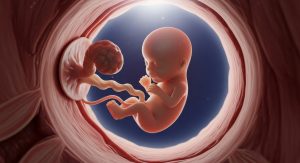
Flavors such as garlic or certain spices have been detected in the amniotic fluid.
5. The Baby Practices Breathing Even Before Birth
Although the baby does not breathe with its lungs while in the womb, it is already practicing this important skill. The lungs develop throughout the entire pregnancy and only begin to perform their actual function after birth.
Inside the mother’s womb, the baby makes what are known as breathing movements:
- The chest rises and falls.
- Amniotic fluid is moved into the airways.
- The respiratory muscles are exercised.
These exercises are crucial for the baby to be able to take its first breath after birth.
6. Babies can Get the Hiccups
Toward the end of pregnancy, many expectant mothers notice regular small movements in their abdomen. These are often the baby’s hiccups. This occurs because the baby is exercising its breathing muscles and swallowing amniotic fluid. Hiccups are usually not a sign of a problem but are part of normal development.
Why are hiccups important?
They show that the nerves, muscles, and diaphragm are working together.
7. The Baby can Perceive Light
Although the baby’s eyes remain closed for a long time, the sense of sight develops during pregnancy. Later, the baby will be able to distinguish between light and dark. Under certain circumstances, strong light sources directed at the abdomen can trigger faint reactions. However, full visual ability does not continue to develop until after birth.

Important to know:
A newborn’s vision is initially still blurry. The development of vision continues intensively after birth.
8. The Baby Sleeps and Develops its own Sleep Phases
Many parents are surprised to learn that unborn babies already have different sleep phases. During pregnancy, a distinct rhythm develops:
- rest phases,
- active movement phases,
- sleep phases.
So-called REM sleep phases, which in humans are associated with dreaming, can also be observed even before birth. Whether babies actually dream in the womb cannot be conclusively proven scientifically. However, brain activity indicates that complex developmental processes are already taking place.
9. The Baby Receives Important Antibodies from the Mother
During pregnancy, the placenta serves not only as a supply system but also as an important protective barrier. Certain antibodies from the mother are passed to the baby via the placenta. These provide the baby with what is known as “nest protection” for the first few months of life. After birth, this protection helps the still-immature immune system cope with various pathogens. However, this protection is not complete—which is why vaccinations and other preventive measures after birth play an important role.
10. Even Before Birth, the Baby is Aware of the Mother’s Surroundings
Pregnancy is not a completely isolated time. The baby perceives many signals from its surroundings.
These include:
- voices,
- the mother’s movements,
- her heartbeat,
- certain sounds,
- and hormonal changes.
The mother’s voice, in particular, plays an important role. After birth, babies can recognize familiar voices and often respond to them. This early bond does not begin only after birth, but starts as early as in the womb.
Conclusion: An Unborn Baby is Already Surprisingly Active Before Birth
A baby’s development during pregnancy is an impressive process. Long before the first cry, the tiny body is already at work: the heart beats, muscles are strengthening, the senses are developing, and the brain is processing its first impressions.
Many of the abilities we associate with a newborn actually begin months earlier. Pregnancy is therefore not only a time of growth but also a phase of intense development and preparation for life outside the womb.
Related Posts
-

As any new parent can attest, there’s no doubt that a newborn baby is fully…
-

Scientists have found the first direct evidence that babies in the womb react differently to…
-

According to a new study by the University of Surrey, the age at which babies…


