
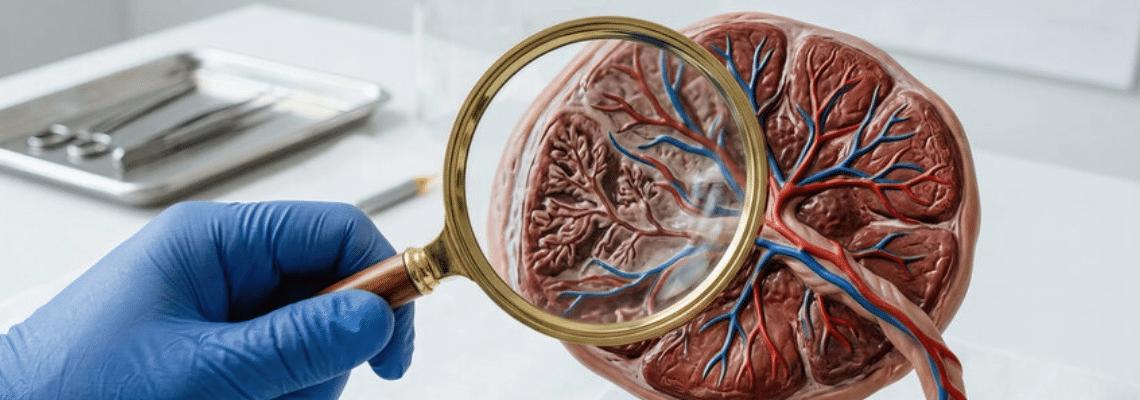
The notion that mental illnesses originate exclusively in the brain is increasingly being challenged by modern research. New findings suggest that crucial developments begin much earlier—namely, during pregnancy. At the heart of this research is an organ that has long been viewed primarily as a “supply structure”: the placenta.
A major European-American research collaboration involving 28 scientists from 18 institutions has recently shown that the placenta not only supplies nutrients and oxygen to the fetus but also actively intervenes in the regulation of early brain development. The focus is particularly on epigenetic mechanisms, especially DNA methylation.
What Does Epigenetics Actually Mean?
Epigenetics describes chemical changes to the DNA or to the proteins surrounding the DNA that control gene activity without altering the actual genetic sequence. You can think of it as a kind of “switch control” for genes: The genes themselves remain the same, but their activity is turned up or down.
A central mechanism is DNA methylation. In this process, small chemical groups—so-called methyl groups—are attached to specific sections of the DNA. These marks influence whether a gene is actively expressed or remains silent. Importantly, these processes are not rigid. They respond to environmental conditions such as:
- The mother’s diet
- Stress during pregnancy
- Inflammatory processes
- Exposure to environmental toxins or pollutants
- General hormonal conditions
In this way, epigenetics links genetic predisposition and environmental factors within a shared biological system.
The Placenta as an “Epigenetic Interface”

The placenta is far more than a passive organ of supply. It functions as a highly active regulatory system between mother and fetus. Among other things, it controls:
- Nutrient transport
- Hormone production
- Immunological signals
- stress responses (e.g., via cortisol regulation)
Current research suggests that the placenta can also transmit epigenetic signals to the developing fetus. This means that changes in DNA methylation in the placenta can influence how genes are later expressed in the developing brain. This perspective is increasingly shifting the focus of psychiatry toward the early developmental phase.
Link to Neuropsychiatric Disorders
The study mentioned above demonstrates particularly strong associations between epigenetic patterns in the placenta and the following disorders:
- Schizophrenia
- Bipolar disorder
- Major depressive disorder
These disorders have long been discussed as “neurodevelopmental”—that is, as disorders that originate in early brain development. The new data now support this hypothesis at the molecular level: Certain methylation patterns in the placenta appear to be linked to genes that are involved in the regulation of neural networks later in life.
This does not mean that these disorders are “determined in the womb.” Rather, a biological risk profile emerges that can influence later susceptibility—depending on other life factors.
ADHD, Autism, and Other Disorders
Correlations have also been observed for other neuropsychiatric and neurodevelopmental disorders—such as ADHD or autism spectrum disorders—though they are less pronounced.
This could suggest that these conditions are more strongly influenced by a combination of:
- genetic factors
- postnatal brain development
- and later environmental conditions
For some other conditions studied, however, no significant associations were found with the epigenetic patterns of the placenta, underscoring the specificity of these effects.
What Does this Mean for Our Understanding of Mental Disorders?

The findings shift the perspective on mental disorders in several key ways:
1. Early biological imprinting
Risk factors may begin even before birth, not just in childhood or adolescence.
2. Interaction of genes and environment
Genetic risk is not static but is modulated by epigenetic mechanisms.
3. The placenta as an active organ
It is not merely a “transit station,” but a regulatory system that influences neurobiological development.
4. No deterministic model
An increased risk does not mean an inevitable illness, but rather an altered biological baseline.
Context and Open Questions
Despite the exciting findings, important questions remain:
- Which specific environmental factors during pregnancy are particularly relevant?
- Can epigenetic patterns be specifically influenced or reversed?
- How stable are these changes over the lifespan?
- What role do paternal factors or early postnatal influences play?
Research in this area is still in its infancy, but it opens up new avenues for prevention and early understanding of mental illnesses.
Related Posts
-

Researchers have found a mechanism in which mice lacking nutrients early in pregnancy have a…
-

Recent information shows that women who had their children after the age of 40 are…
-

A serious medical condition known as gestational diabetes may precipitate heart disease in women. The…


