

A study published by the Medical University of Vienna shows that certain immune cells in the mother take on a surprising role in early pregnancy: they support the development and implantation of the placenta. The study appeared in Science Immunology. This is an interesting topic because it doesn’t sound like a typical “pregnancy guide,” but rather explains a new scientific finding.
The Surprising Role of the Immune System During Pregnancy
The mother’s immune system must perform an extraordinary task during pregnancy. It must continue to protect the body from pathogens—while simultaneously enabling a pregnancy in which tissue that is, in part, genetically foreign develops within the mother’s body. How exactly this balancing act works is still far from fully understood.

A new study from the Medical University of Vienna now provides a surprising insight: Certain immune cells in the mother, known as neutrophils, apparently support the development and implantation of the placenta in early pregnancy. The results show that these immune cells can alter their properties depending on their environment. Instead of triggering an inflammatory response, they help placental cells migrate into the uterine lining during early pregnancy.
The Placenta Must Implant itself Deep Within the Maternal Tissue
Something amazing happens at the beginning of a pregnancy. The placenta forms and must establish a connection with the maternal tissue. To do this, specialized placental cells—known as extravillous trophoblasts—migrate into the uterine lining. This process is crucial for the further course of the pregnancy.
Not only must the placenta be securely anchored to the uterus, but it must also modify the blood supply so that the growing embryo or fetus can be adequately supplied with oxygen and nutrients.
To achieve this, the blood vessels of the uterus must be remodeled during early pregnancy. The new Vienna study focuses precisely on this early interaction between the maternal immune system and the placenta.
Neutrophils: Normally Part of the First Line of Immune Defense
Neutrophils are among the most common white blood cells in the human immune system. Their classic role is well known: they react quickly to pathogens and can trigger inflammatory responses. This makes them an important part of the innate immune system. In early pregnancy, however, certain neutrophils appear to take on a different role.
The researchers found a particularly high number of these immune cells in the area between the maternal tissue and the placenta. There, they differed significantly from neutrophils circulating in the normal bloodstream. This is particularly interesting because it shows that immune cells do not necessarily have the same function everywhere. Their environment appears to play a decisive role in determining what they do.
The Placenta Can, in a Sense, Reprogram Immune Cells
This is precisely where one of the study’s most exciting observations lies. The researchers compared neutrophils from the blood with neutrophils found in the tissue surrounding the early placenta. In laboratory experiments, the different cell types exhibited surprisingly different behaviors. Blood neutrophils were initially able to damage placental cells. Neutrophils from early-pregnancy tissue, on the other hand, supported the motility of placental cells.
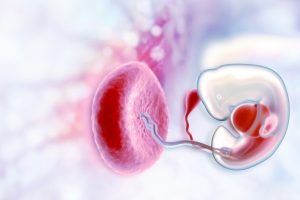
Even more remarkable was what happened next. The researchers were able to show that signals from the placenta’s surroundings can cause blood neutrophils to change their behavior. After this adaptation, the cells no longer caused comparable damage but instead also supported the movement of placental cells. The placenta thus apparently influences the function of the immune cells surrounding it.
One Molecule Plays an Important Role in this Process
The researchers also found evidence suggesting which molecular processes might be involved in supporting the placental cells. One such molecule is MMP-9, an enzyme that can alter components of the tissue microenvironment. The study’s results suggest that MMP-9 may contribute to the motility of placental cells. Signals such as TGF-β are also associated with the altered function of the neutrophils.
This highlights how closely the cells of the early placenta collaborate with the maternal immune system. Immune cells not only respond to their environment but, under the conditions of early pregnancy, can support processes that are important for the development and implantation of the placenta.
Pregnancy Does Not Simply Mean a “Weaker Immune System”
This new research aligns with a major shift in our understanding of the immune system during pregnancy. For a long time, it was simplistically assumed that the immune response is generally suppressed during pregnancy. Today, researchers know that this view is too simplistic.
The immune system changes during pregnancy. Certain immune responses are attenuated, while others are amplified or take on new roles. The current findings demonstrate particularly impressively that immune cells in the vicinity of the placenta can apparently be functionally reprogrammed. In doing so, the cells do not fundamentally lose their ability to defend the body. Rather, they respond depending on the signals they receive from their environment.
Why the Placenta Is So Important
The placenta is far more than a simple connection between mother and child. It performs numerous functions during pregnancy. It facilitates the exchange of oxygen and nutrients, produces hormones, and plays a crucial role in the mother’s body’s adaptation to pregnancy. For the placenta to fulfill these tasks, its development must proceed with great precision.
Early placentation, in particular, is a critical process. Placental cells must invade the maternal tissue and modify the uterine blood vessels so that sufficient blood can flow to the placenta later on. The new findings suggest that the maternal immune system actively supports this process.
What Happens if this Mechanism Does Not Function Properly?
The researchers also see their findings as a potential starting point for future studies on pregnancy complications. Insufficient invasion of placental cells and impaired remodeling of the maternal blood vessels are associated, among other things, with pregnancy complications such as preeclampsia and restricted fetal growth.
However, the new study does not prove that a malfunction of the described immune cells causes a specific pregnancy complication. Rather, the researchers emphasize that it must now be investigated whether and how the function of these immune cells changes in the context of pregnancy complications. This is an important distinction.
The study provides a new mechanism and a possible explanation for certain processes in early pregnancy—but it is not yet a diagnostic test or a new treatment method.
Further Evidence Comes from Current Placenta Research
Another study from 2026 also demonstrates how rapidly this field of research is currently advancing. Researchers examined the blood marker Isthmin-2 during the first trimester of pregnancy. Low concentrations of this protein were already associated with the later onset of preeclampsia or fetal growth restriction as early as the 12th week of pregnancy.
The results were confirmed in two independent cohorts. Furthermore, experimental research showed that Isthmin-2 may be involved in the ability of placental cells to invade maternal tissue.
This points to an interesting field of research: Scientists are increasingly seeking to understand very early changes in the placenta, long before certain pregnancy complications become clinically apparent.
Early Pregnancy is Biologically Particularly Complex
The new findings highlight just how complex the first weeks of pregnancy are. Placental cells, blood vessels, immune cells, and signaling molecules interact closely with one another. This is not a static system. Cells alter their properties depending on their environment and respond to signals from other cells.
The placenta is therefore not simply an organ that forms after fertilization and then passively fulfills its functions. Rather, it is part of a highly dynamic biological network. For pregnant women, it is important first and foremost to interpret the results correctly. The study describes fundamental biological processes of early pregnancy. It does not mean that women should now try to influence their immune systems or take specific measures. There are currently no new recommendations based on this research regarding diet, exercise, or medical care during pregnancy.
The true value of the research lies primarily in a better understanding of the processes that enable healthy placental development. In the long term, this knowledge could help us better understand why some pregnancies proceed without complications while others result in placental problems.
Conclusion: The Mother Helps the Placenta – and the Placenta Alters the Immune Response
Perhaps the most important finding of the new study is not that immune cells suddenly take on a completely new role. Rather, it demonstrates just how adaptable the human immune system is. A cell that normally fights pathogens and can trigger inflammation can, in the right environment, play a supportive role in one of the most important developmental processes of human life. Pregnancy is therefore not a state in which the immune system is simply shut down. Rather, it is reorganized and functionally adapted.
The new study from the Medical University of Vienna provides a fascinating insight into early pregnancy. Certain maternal neutrophils apparently support the migration of placental cells into the uterine lining. At the same time, the environment surrounding the placenta can cause other neutrophils to alter their behavior and also participate in this process. This demonstrates once again that pregnancy involves more than just changes in the mother and child.
A complex biological system develops between the two, in which the placenta, the immune system, and maternal tissue are in constant communication with one another. It is not yet clear what role these mechanisms play in pregnancy complications. But this is precisely where the significance of the research lies: the better scientists understand how a healthy placenta develops, the better they may be able to understand the causes of placental dysfunction. Pregnancy, therefore, does not only change the mother’s body; it also changes the way her immune system interacts with the placenta.
Related Posts
-

The immune system changes throughout pregnancy. These fluctuations have implications both for the mother's health…
-

It is essential for expectant mothers to eat enough protein during pregnancy because it helps…
-

The benefits and general impacts of selenium were previously unknown, but with advances in modern…


