

Artificial intelligence is increasingly finding its way into medicine. This technology could also play an important role in prenatal care in the future. Researchers are working on systems that can analyze large amounts of medical data and identify potential pregnancy risks. The hope is that certain complications could be detected earlier, allowing doctors to respond more quickly and tailor care to individual needs. However, artificial intelligence is not yet a replacement for traditional prenatal care. Rather, current developments show how AI could support healthcare professionals in the future.
How Can AI Help During Pregnancy?
A great deal of information is collected during pregnancy. This includes, for example, blood test results, blood pressure readings, ultrasound findings, pre-existing conditions, medications, and details about the course of the pregnancy so far.
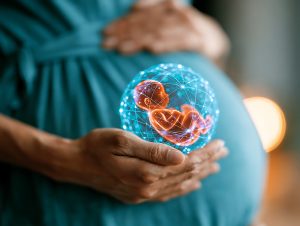
It is time-consuming for healthcare professionals to compare all this information over the course of many months. Artificial intelligence, on the other hand, can analyze large amounts of data in a short time and search for specific patterns. This is precisely where current research comes in.
For example, AI could recognize that a certain combination of several measurements occurs more frequently in women who were later diagnosed with a pregnancy complication. The goal is not for the AI to make a diagnosis on its own. Rather, it could provide an indication that a more detailed examination might be warranted.
New Research Explores AI for Mothers and Children
A recent research paper from 2026 demonstrates how far development has already progressed. Researchers have developed an AI system capable of linking health data from mothers and their children. The system does not merely consider individual tests. The system attempts to account for the progression of pregnancy over time. Several million medical examinations and doctor visits were analyzed to develop the model.
One of the goals was to predict various risks related to pregnancy and childbirth. These included, for example, preterm labor, premature rupture of membranes, and certain placental issues. The results are interesting but must be interpreted correctly: this is research. This does not mean that pregnant women can simply use such AI today to reliably determine their personal risk.
Can AI Detect Risks Early in Pregnancy?
Early pregnancy is a particularly interesting area. If an increased risk can be detected as early as the first trimester, doctors might be able to decide sooner whether additional tests or more frequent monitoring are necessary.
Research using very large datasets is now underway in this area as well. For example, AI models are being trained to predict later complications based on early information about a pregnancy. However, this also highlights an important challenge: AI does not automatically work equally well for everyone.
If a model has been trained primarily with data from a specific population group, the results may be less accurate for other population groups. That is why such systems must be tested using diverse data and across different countries and healthcare systems.
Preeclampsia: An Important Area of Research
Of particular interest is the use of AI for pregnancy complications where early detection is crucial. This includes preeclampsia. It can occur during pregnancy and is associated with, among other things, high blood pressure. In severe cases, it can be dangerous for both mother and child.

Researchers are therefore exploring various ways to identify women at increased risk as early as possible. AI could take various pieces of information into account simultaneously. These could include, for example, blood pressure readings, lab results, medical history, and results from previous examinations.
New biomarkers are also currently being researched. A biomarker is a measurable biological value that can provide clues about specific processes in the body. In the future, such information could potentially be analyzed by AI systems in conjunction with other medical data.
AI Is Intended to Support Doctors—Not Replace Them
Despite all the enthusiasm for the technical possibilities, one point remains particularly important: Artificial intelligence cannot replace a doctor or a midwife. An AI system can calculate probabilities and recognize patterns. However, it does not automatically know all the individual circumstances of a pregnant woman and cannot make medical decisions independently and responsibly.
Furthermore, an increased risk does not mean that a complication will actually occur. For example, if an AI calculates an increased risk of preterm birth based on certain data, this is initially a statistical assessment. The treating healthcare professionals must then decide how to interpret this result from a medical perspective.
What Data Does AI Need?
For AI to function effectively, it requires extensive medical information.
This may include, among other things:
- Blood pressure readings
- Blood tests
- Week of pregnancy
- Pre-existing conditions
- Previous pregnancies
- Previous births
- Ultrasound examinations
- Medications
- Information on the child’s development
- Pregnancy history to date
The trend over time is particularly interesting. A single value may be normal. However, multiple measurements taken over a longer period can reveal that something is changing. AI is especially quick at comparing precisely these kinds of changes.
What Benefits Could AI Offer Pregnant Women?
If the technology proves effective in practice, it could offer various benefits. For example, AI could alert medical staff that certain values should be rechecked. This could potentially allow abnormalities to be detected earlier.
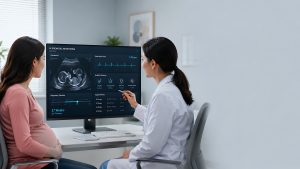
More personalized care would also be conceivable. Instead of relying exclusively on general risk factors, multiple personal factors could be considered together. Another potential benefit is reducing the workload on medical staff. Especially when dealing with large volumes of health data, AI could help identify relevant information more quickly.
But There are Also Risks
The use of artificial intelligence in medicine brings not only opportunities. A major concern is data protection. Health data is particularly sensitive personal information. Therefore, there must be clear regulations governing which data is used, who can access it, and how it is protected.
Erroneous assessments are also possible. AI can only be as reliable as the data used to develop and test it. If certain population groups are underrepresented in the training data, this can lead to inaccurate results. Furthermore, it must be clear to medical staff why a system has issued a particular risk assessment.
Will AI Soon Be Part of Every Pregnancy?
It is still too early to say whether artificial intelligence will become an integral part of every pregnancy in the near future. There are several steps between a successful research project and a medical system that is actually approved for use in everyday practice.
The technology must undergo extensive testing. Its reliability must be demonstrated across different population groups. Furthermore, it must be clarified how it can be safely integrated into medical care. For pregnant women, this currently means above all that AI is an exciting field of research, but it is no substitute for regular prenatal care.
What Might Prenatal Care Look Like in the Future?
One possible scenario is prenatal care in which medical data is more closely integrated. For example, AI could analyze the course of a pregnancy over several months and alert doctors to specific changes. In doing so, it could evaluate not just individual test results, but a wide range of information collectively. The decision would still rest with medical professionals. AI would serve more as an additional tool to help analyze large amounts of data and identify potential risks more quickly.
Artificial intelligence could significantly transform prenatal care in the future. Current research shows that AI can analyze large amounts of medical data and identify certain pregnancy risks. Of particular interest is the ability to link information about the course of a pregnancy, which could potentially lead to earlier detection of specific risks. However, further research is needed before AI is actually used routinely in prenatal care.
For expectant parents, therefore, the most important thing remains the same for now: Personal care from doctors and midwives cannot be replaced by current AI systems. In the future, however, AI could become an additional tool that helps medical professionals identify risks earlier and provide even more personalized care during pregnancy.
Related Posts
-

Pregnancy at 38 years of age or older is a bit riskier than it was…
-

Pregnancy disorders are usually diagnosed in the second or third trimester of pregnancy, when they…
-

Celiac disease is one of the most common autoimmune conditions. If you are pregnant and…


