
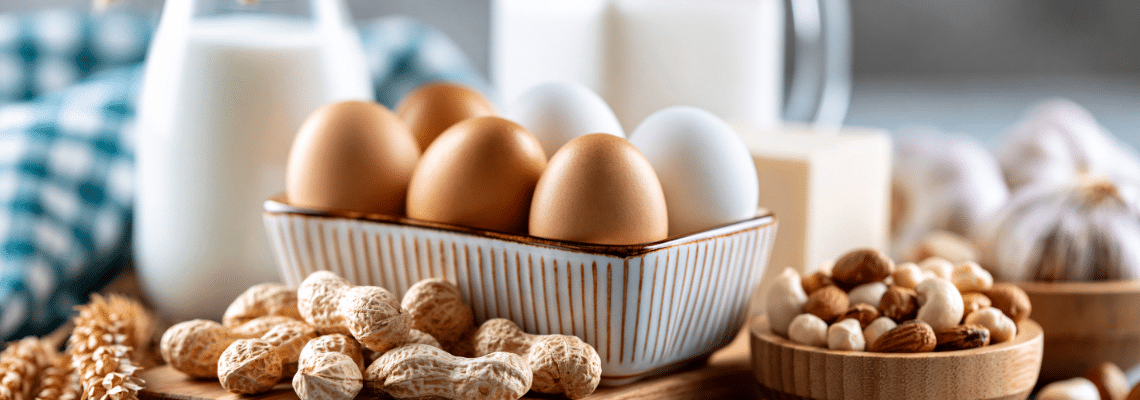
What a woman eats during pregnancy is a concern for many expectant mothers. However, it’s no longer just about providing the unborn child with vitamins, minerals, and energy. The development of the immune system is also increasingly taking center stage.
One specific question is: Can an expectant mother’s diet influence whether her child will later develop a food allergy? Theoretically, that’s certainly possible. Components of food can come into contact with the unborn child during pregnancy via the placenta or amniotic fluid. After birth, certain food components can also be passed on through breast milk. A large Australian study now provides important new insights: consuming particularly large amounts of eggs and peanuts during pregnancy and breastfeeding did not reduce the children’s risk of allergies. The results were published in the New England Journal of Medicine.
The Idea Behind the Study
Food allergies do not develop only when a child eats a particular food for the first time. The immune system develops very early in life. This led to the question of whether a particularly early exposure to potential allergens might contribute to the development of what is known as immune tolerance.
With tolerance, the immune system recognizes a substance that is actually harmless without triggering a pathological immune response. If an unborn or breastfed child comes into contact with tiny amounts of certain food components even before the introduction of solid foods, this could theoretically support such an accustoming effect.
This was precisely the hypothesis behind the Australian PrEggNut study. The researchers did not simply want to observe what women were eating anyway; they randomly assigned participants to different dietary groups. This allows for a much more reliable investigation of whether increased intake of eggs and peanuts actually influences the later development of allergies.
More than 2,000 Pregnant Women Participated
A total of 2,137 pregnant women from four Australian cities took part in the study. The participants were enrolled before the 23rd week of pregnancy. Of particular interest was that their unborn children had an increased familial risk of allergies: At least two first-degree biological relatives had to have a medically diagnosed allergic condition. Women who themselves had an egg or peanut allergy were excluded from the study.
The participants were then randomly assigned to two groups. The women in the group with the increased intake were instructed to eat at least six eggs and 60 peanuts per week. The control group, on the other hand, was instructed to consume no more than three eggs and 30 peanuts per week. This diet was maintained from pregnancy through four months after birth or for the duration of breastfeeding, whichever applied.
The Result Was Surprisingly Clear
With this experimental design, the researchers sought to determine whether a higher intake of these two foods would later result in a measurable difference in the children. However, this was not the case. By the age of one, 7.8 percent of the children in the group with high egg and peanut intake had developed an IgE-mediated allergy to eggs or peanuts. In the control group, the figure was 8.4 percent.
The difference was not statistically significant. The relative risk was 0.93; the 95-percent confidence interval ranged from 0.69 to 1.26. The statistical test also yielded no convincing evidence of protection from increased maternal intake. In other words: The children did not appear to benefit from their mothers having eaten particularly large amounts of eggs and peanuts.
The researchers also examined the two allergies separately. An IgE-mediated egg allergy was diagnosed in 6.2 percent of the children in the group with high maternal intake. In the control group, the figure was 7.2 percent. In contrast, the rate of peanut allergy was 2.6 percent in both groups. These differences also failed to provide convincing evidence that particularly high maternal consumption reduces a child’s risk of developing an allergy.
What Does “IgE-Mediated Allergy” Mean?
This term is important because not every intolerance to a food automatically constitutes a classic food allergy. In an IgE-mediated allergy, the immune system reacts to a protein that is actually harmless by producing specific antibodies of the immunoglobulin E type, or IgE for short. Upon repeated exposure, these antibodies can trigger an allergic reaction. Symptoms can affect, for example, the skin, respiratory tract, or the gastrointestinal tract and, in severe cases, can trigger anaphylaxis.
In the Australian study, therefore, researchers did not simply rely on questionnaires to assess whether a child might be allergic. Instead, they used medical tests such as skin prick tests and food challenges, with the evaluators remaining unaware of which dietary group the respective mother had belonged to.
There was also no significant difference regarding eczema. The study was not limited exclusively to egg and peanut allergies; the occurrence of medically diagnosed eczema was also recorded. By the age of twelve months, 42.8 percent of the children in the group with high maternal egg and peanut intake were affected. In the comparison group, the figure was 46.2 percent. This, too, provides no convincing evidence that particularly high consumption of eggs and peanuts during pregnancy and breastfeeding prevents allergic diseases in children.
The Study Does Not Contradict the Idea of Early Allergy Prevention
At first glance, the result might be confusing. If early exposure to allergens is potentially helpful—why doesn’t it already work through the mother’s diet? The key point is how and when the immune system comes into contact with the allergen.
Previous research has shown that the targeted introduction of certain allergenic foods directly to infants can have a protective effect. The LEAP study, in which the early introduction of peanuts to infants at increased risk of allergies significantly reduced their later risk of a peanut allergy, became particularly well-known.
The PrEggNut study, on the other hand, explores a different approach: exposure initially occurs through the mother—that is, during pregnancy and breastfeeding. The two situations are therefore not equivalent.
The Key Difference May Lie With the Infant Itself
Current research on allergy prevention has changed significantly in recent years. For a long time, the prevailing view was that infants should be kept away from allergenic foods for as long as possible. There is now strong evidence that the timely and regular introduction of certain allergenic foods during infancy can support the development of tolerance. The current PrEggNut study does not call this concept into question.

Rather, it shows that additional protection does not appear to result from the mother consuming particularly large amounts of the relevant foods during pregnancy and breastfeeding. A recent review in the New England Journal of Medicine therefore describes the results as reassuring rather than as a call for a specific dietary strategy.
What Pregnant Women Can Take Away From This
The results do not mean that pregnant women should avoid eggs or peanuts. That is an important distinction. The study compared normal or more limited intake with a deliberately increased intake. It shows that eating large amounts of these foods did not provide any detectable protection against allergies for the child. For an expectant mother, this therefore provides no reason to eat eggs or peanuts in unusually large quantities solely for the purpose of allergy prevention. Similarly, the study does not suggest that a woman should generally avoid these foods if she tolerates them well.
What About Women Who Have an Allergy Themselves?
Special caution is important here. Women with a known egg or peanut allergy were excluded from the study. The results therefore cannot be interpreted as a recommendation that women with their own food allergies should deliberately consume these foods during pregnancy. In cases of a known allergy, individual medical recommendations apply.
Nor can general nutritional advice be derived from this study for other nutritional issues during pregnancy—such as a specific metabolic condition, nutritional deficiency, or other medical problems.
Why the Results Are Still Important
The study is particularly interesting because it tested a very specific hypothesis: Could a child’s allergy development be influenced as early as during pregnancy by the mother intentionally eating more allergenic foods? According to the available data, the answer is that no such additional effect can be detected.

This is scientifically valuable. Even a well-founded hypothesis does not necessarily have to be confirmed. Large randomized studies, in particular, can help distinguish dietary recommendations from plausible but unproven assumptions.
Despite its size, this study is not without limitations. The observed prevalence of allergies was lower than originally assumed when the study was designed. Furthermore, the study could not completely rule out the possibility of a moderate protective effect, as the confidence interval does not entirely exclude a relative risk reduction of approximately 30 percent. Furthermore, the participants knew which dietary group they had been assigned to. Complete blinding was practically impossible in a dietary study.
In addition, the study population consisted predominantly of a relatively well-educated and predominantly white demographic. Whether the results apply equally to other demographic groups therefore requires further investigation.
The Most Important Allergy Prevention Apparently Begins Later
The results are part of a trend that has significantly transformed allergy research in recent years. The crucial question seems to be less about whether the mother eats as many allergenic foods as possible during pregnancy. Rather, the focus is shifting toward the targeted introduction of appropriate allergenic foods in early infant feeding.
This does not mean that every baby should be given every allergen as early as possible, regardless of their individual situation. The timing and method of introduction should be age-appropriate. For children at high risk of allergies—or, in particular, those with severe eczema—it may be advisable to consult a doctor before introducing certain foods.
German guidelines now also recommend the early, age-appropriate introduction of certain allergenic foods for allergy prevention and do not advise blanket avoidance.
Conclusion: Eating More Eggs and Peanuts Apparently Does Not Protect the Baby from Allergies
The large PrEggNut study provides an important answer to a long-standing question: Eating particularly large amounts of eggs and peanuts during pregnancy and breastfeeding does not appear to reduce the risk of an egg or peanut allergy in children during their first year of life. For pregnant women, this means one thing above all: Based on these data, there is no reason to eat these foods in unusually large quantities just to reduce the child’s future risk of allergies.
At the same time, the study does not support avoiding eggs or peanuts for women who can tolerate these foods. The research thus shifts the focus further toward the child’s early diet. There is now much stronger evidence that the timely and regular consumption of certain allergenic foods during infancy can play an important role in the development of immune tolerance.
Pregnancy undoubtedly remains a crucial phase for the development of the immune system. However, the new study shows that a particularly high intake of eggs and peanuts by the mother alone does not appear to be the decisive factor in preventing later food allergies in the child.
Related Posts
-

When you are pregnant, you have to give a lot of thought to what you are…
-
During every mother's pregnancy, there are often concerns about food intake and overall weight. However, one…
-

A healthy pregnancy diet is vital to a healthy pregnancy term. Nutritious pregnancy food is…


